

impermanence
your scars will fade

As a child, I would dismember my dolls. The act wasn’t out of a psychotic desire to inflict gruesome violence or a much more innocent passion for anatomy, but rather an inexplicable urge to ruin things that I believed to be ‘too perfect’. The idea of something staying so pristine and intact for the abstract notion of forever made me feel so inexplicably uneasy that my hand often gravitated towards the hot pink children’s scissors sat atop my desk, giving them a tangible although artificial end in my eyes. Impending doom more or less became the broader theme of my formative years. Constantly expecting the end of everything became my norm, a crutch even. In elementary school, I had permanently etched into my head the idea that I would not make it to 3rd grade, fully expecting to cease existing altogether. In 3rd grade, the goalpost was set further back to middle school, then junior high, and as far back as it needed to go to choke out any semblance of validation for a future I desperately didn’t want to think about.
Last summer, on the floor of a Racetrac, I lay there sobbing, genuinely thinking that this was the end I had concocted in my head all those years. Sandwiched between obscene amounts of soft drink options and an imposing rack of gas station hotdogs, I felt the world cave in on me, my breath escaping my body. I felt as though my brain had turned into mush and I was crying it out. In that moment everything felt so implicated. There was no nebulous future to tank the impacts. This was it. The weight of losing something I never even imagined as separate from myself struck me down all at once. Months went by, and I stayed deadly still while the world passed me by. I couldn’t even bring myself to drastically arrange a means for the end because in my mind this was it. Obviously (although it didn’t feel like it at the time), it was not. Though I felt like something was ripped from my soul, at the end of the day my limbs all stayed intact. Little by little with help, I learned to crawl, then walk, and even run again. Now, what was once the literal end of the world is just a memory.
I don’t think time heals us per se, rather weathers memories down, stripping them of their sharp, cutting edges. As the haze grows thicker, our minds are able to trivialize these experiences, revealing the true impermanence of it all. Car Seat Headrest’s magnum opus Twin Fantasy (Face to Face), is a saccharine tragedy about queer teenage love and its all-consuming nature. Starting as a solo project, a 17-year-old and heartbroken Will Toledo wrote and recorded the original tracks which were later repurposed for the original Twin Fantasy album in the backseat of his car, making way for one of the most beautiful metaphors about grief.
Twin bruises on my shins
From where I kicked the back of the seat in
They meant what I went through for you
But now they're fading, now they're gone
- Famous Prophets (Stars), Carseat Headrest
As scars inevitably fade into oblivion, so do memories. Looking down at my fingertips, I see the hot glue burns I acquired while making a sculpture. Their sharpness has dulled, much like the grief that went into the piece, morphing into something unrecognisable entirely, faint and blurry. Similarly, the aforementioned bruises not only serve as a physical manifestation of the melange of emotions Will harboured towards his ex-lover but also an indicator of the time that passed and their merging into something symbolic rather than real.
Much like Proust’s madeleines and tea, memories lay dormant within us, waiting to be called upon by some sensory trigger.
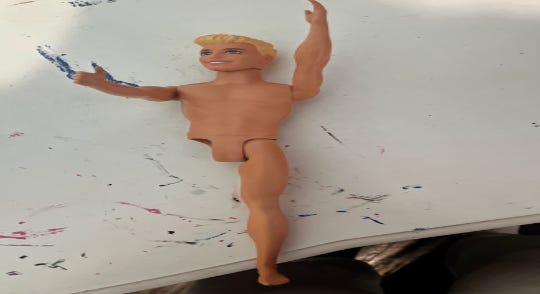
Once we sip that tea or disfigure that poor toy for a school project, the pocketed memories which are intrinsically linked to the physical sensations surface. Proust says it best.
“But its struggles are too far off, too much confused; scarcely can I perceive the colourless reflection in which are blended the uncapturable whirling medley of radiant hues, and I cannot distinguish its form, cannot invite it, as the one possible interpreter, to translate to me the evidence of its contemporary, its inseparable paramour, the taste of cake soaked in tea; cannot ask it to inform me what special circumstance is in question, of what period in my past life.”
-Marcell Proust, Rememberance of Things Past
Far too often I feel like I take on the role of a mere observer in my own life, my actions and experiences separate so separate from the person they made me. As the cold becomes more pervasive, so does my desire to rot in my bed, swiping through my camera roll aimlessly. I tap on my phone screen with the blend of curiosity and spectacle akin to that of a child calling for the attention of the fishes in the aquarium. Similarly, the medley of emotions teeming within the bounds of the photo, swim towards my call, revealing their faint shape, but they are inevitably stopped by the glass of my phone screen, barred from pervading reality. They now exist in another plane. Through the fallen strands of hair and torn skin surrounding my eyes, they are brought back to me, even then only in passing.
Once the scars fade so will you. But so will the pain.
My skin now lays bare anticipating its new wounds and inevitably new scars.